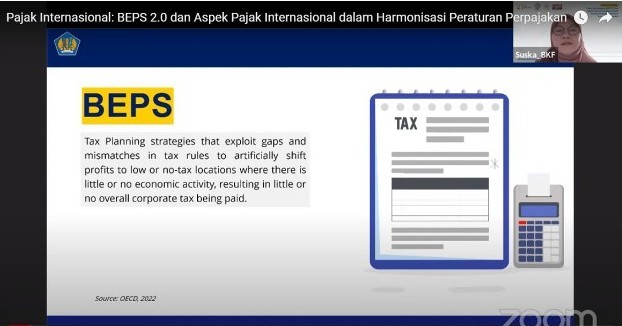
BEPS (Base Erosion and Profit Shifting) is a term used by G-8, G-20 and Organisation for Economic Co-Operation and Development (OECD) member countries to describe the business practices of multinational enterprises (MNEs) to transfer their business profits through transfer pricing schemes to other countries that apply low/zero tax rates (Wells and Lowel, 2013, p. 3).
The OECD/G20 Inclusive Framework on Based Erosion and Profit Shifting (IF) has approved a two-pillar solution to address tax challenges arising from the digitalization of the economy.
Pillar I deals with the unified approach while Pillar II deals with Global anti-Base Erosion Rules (GLoBE). The development of Pillar I was explained by Suska, an Associate Policy Analyst of Fiscal Policy Agency (Badan Kebijakan Fiskal or BKF) in "International Taxes: BEPS 2.0 and International Tax Aspects in the Harmonization of Tax Regulations Law" webinar which was held to celebrate the 7th Anniversary of Faculty of Administrative Sciences, University of Indonesia (18/03/22).
BEPS implementation can be detrimental and pose a threat to other countries. Losses due to BEPS range from USD100-240 billion or equivalent to 4-10% of global corporate income tax revenues.
Realizing this, within the OECD/G20 Inclusive Framework, 141 jurisdictional countries have implemented 15 actions aimed at tackling tax avoidance, increasing cooperation in regulating international taxes, ensuring a more transparent taxation system, and to address tax challenges arising from economic digitization.
The Pillar I focuses on how right of income tax from business activities in digital era should be allocated to each jurisdiction. This pillar introduces a new approach to allocate the right of tax by considering the amount of user participation, marketing intangibles, and significant economic presence.
The concept of Pillar I is satisfactory because it gives taxation rights to the market country for non-physical form aspect. Pillar I targets all MNEs with a global turnover of over 20 billion Euro (approximately 23.5 billion USD) and profitability (earnings before tax/income) above 10%.
The global gross turnover threshold can be reduced to 10 billion Euro (approximately 11.8 billion USD) after 7 years of the agreement with a review lasting no more than 1 year.
Furthermore, Pillar II focuses on the global minimum tax, in particular through the Income Inclusion Rule (IIR) scheme. This pillar will guarantee MNEs which meet certain criteria and specified threshold to pay an effective corporate income tax rate of 15%, wherever they are located.
The IIR scheme imposes an additional tax burden (top-up tax) on the parent entity based on the income of the lower-tax group member. The goal of the global minimum tax is to protect Indonesia's tax base by reducing the pressure to engage in tax competition on the basis of competitiveness.